顯示具有 數位內容 標籤的文章。 顯示所有文章

6/02/2023

Generative AI

S. Huang, P. Grady, and GTP-3, Generative AI: A Creative New World, Sequoia Capital (紅杉資本), September 19, 2022.

A powerful new class of large language models is making it possible for machines to write, code, draw and create with credible and sometimes superhuman results.

5/09/2023

Optimization in Online Content Recommendation Services

Omar Besbes, Yonatan Gur, Assaf Zeevi, Optimization in Online Content Recommendation Services: Beyond Click-Through Rates, 18(1), pp. 15–33, Manufacturing & Service Operations Management, Volume 18, Issue 1, Winter 2016. 

A new class of online services allows Internet media sites to direct users from articles they are currently reading to other content they may be interested in. This process creates a “browsing path” along which there is potential for repeated interaction between the user and the provider, giving rise to a dynamic optimization problem. A key metric that often underlies this recommendation process is the click-through rate (CTR) of candidate articles. Whereas CTR is a measure of instantaneous click likelihood, we analyze the performance improvement that one may achieve by some lookahead that accounts for the potential future path of users. To that end, by using some data of user path history at major media sites, we introduce and derive a representation of content along two key dimensions: clickability, the likelihood to click to an article when it is recommended; and engageability, the likelihood to click from an article when it hosts a recommendation. We then propose a class of heuristics that leverage both clickability and engageability, and provide theoretical support for favoring such path-focused heuristics over myopic heuristics that focus only on clickability (no lookahead). We conduct a live pilot experiment that measures the performance of a practical proxy of our proposed class, when integrated into the operating system of a worldwide leading provider of content recommendations, allowing us to estimate the aggregate improvement in clicks per visit relative to the CTR-driven current practice. The documented improvement highlights the importance and the practicality of efficiently incorporating the future path of users in real time.
5/07/2022

Outracing champion Gran Turismo drivers with deep reinforcement learning

Wurman, P.R., Barrett, S., Kawamoto, K. et al. Outracing champion Gran Turismo drivers with deep reinforcement learning. Nature 602, 223–228 (2022). https://doi.org/10.1038/s41586-021-04357-7.

Many potential applications of artificial intelligence involve making real-time decisions in physical systems while interacting with humans. Automobile racing represents an extreme example of these conditions; drivers must execute complex tactical manoeuvres to pass or block opponents while operating their vehicles at their traction limits. Racing simulations, such as the PlayStation game Gran Turismo, faithfully reproduce the non-linear control challenges of real race cars while also encapsulating the complex multi-agent interactions. Here we describe how we trained agents for Gran Turismo that can compete with the world’s best e-sports drivers. We combine state-of-the-art, model-free, deep reinforcement learning algorithms with mixed-scenario training to learn an integrated control policy that combines exceptional speed with impressive tactics. In addition, we construct a reward function that enables the agent to be competitive while adhering to racing’s important, but under-specified, sportsmanship rules. We demonstrate the capabilities of our agent, Gran Turismo Sophy, by winning a head-to-head competition against four of the world’s best Gran Turismo drivers. By describing how we trained championship-level racers, we demonstrate the possibilities and challenges of using these techniques to control complex dynamical systems in domains where agents must respect imprecisely defined human norms.

2/12/2022

YouTube video streaming now using A.I. that mastered chess and Go

JEREMY KAHN, YouTube video streaming now using A.I. that mastered chess and Go, Fortune, February 11, 2022.

The artificial intelligence algorithm, called MuZero, was developed by YouTube’s London-based sister company within Alphabet, DeepMind, which is dedicated to advanced A.I. research. When applied to YouTube videos, the system has resulted in a 4% reduction on average in the amount of data the video-sharing service needs to stream to users, with no noticeable loss in video quality.

7/19/2021

Linear Algebra, Signal Processing, and Wavelets - A Unified Approach

Øyvind Ryan, Linear Algebra, Signal Processing, and Wavelets - A Unified Approach, Python Version, Springer, 2019.  (code, Python)

1 Sound and Fourier Series

2 Digital Sound and Discrete Fourier Analysis

3 Discrete Time Filters

4 Motivation for Wavelets and Some Simple Examples

5 The Filter Representation of Wavelets

6 Constructing Interesting Wavelets

7 The Polyphase Representation of Filter Bank Transforms

8 Digital Images

9 Using Tensor Products to Apply Wavelets to Images

Appendix Basic Linear Algebra 

7/11/2021

Numerical Algorithms: Methods for Computer Vision, Machine Learning, and Graphics

Justin Solomon, Numerical Algorithms: Methods for Computer Vision, Machine Learning, and Graphics,  1st Edition, A K Peters/CRC Press, 2015. (pdf)

Numerical Algorithms: Methods for Computer Vision, Machine Learning, and Graphics presents a new approach to numerical analysis for modern computer scientists. Using examples from a broad base of computational tasks, including data processing, computational photography, and animation, the textbook introduces numerical modeling and algorithmic design from a practical standpoint and provides insight into the theoretical tools needed to support these skills.

The book covers a wide range of topics—from numerical linear algebra to optimization and differential equations—focusing on real-world motivation and unifying themes. It incorporates cases from computer science research and practice, accompanied by highlights from in-depth literature on each subtopic. Comprehensive end-of-chapter exercises encourage critical thinking and build students’ intuition while introducing extensions of the basic material.

The text is designed for advanced undergraduate and beginning graduate students in computer science and related fields with experience in calculus and linear algebra. For students with a background in discrete mathematics, the book includes some reminders of relevant continuous mathematical background.

1/21/2021

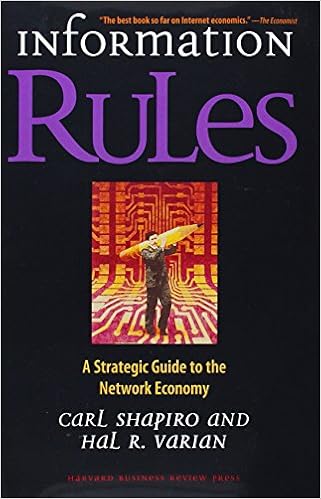
Information Rules (資訊經營法則)


C. Shapiro and H.R. Varian, Information Rules: A Strategic Guide to the Network Economy, Harvard Business School Press, 1998.
張美惠翻譯,資訊經營法則,時報出版,2000
In Information Rules, authors Shapiro and Varian reveal that many classic economic concepts can provide the insight and understanding necessary to succeed in the information age. They argue that if managers seriously want to develop effective strategies for competing in the new economy, they must understand the fundamental economics of information technology. Whether information takes the form of software code or recorded music, is published in a book or magazine, or even posted on a website, managers must know how to evaluate the consequences of pricing, protecting, and planning new versions of information products, services, and systems. The first book to distill the economics of information and networks into practical business strategies, Information Rules is a guide to the winning moves that can help business leaders navigate successfully through the tough decisions of the information economy.
本書歸納的經濟法則歷久彌新,值得推薦給學生和專業人士了解
Chapter 1 of Information Rules begins with a description of the change brought on by technology at the close of the century--but the century described is not this one, it's the late 1800s. One hundred years ago, it was an emerging telephone and electrical network that was transforming business. Today it's the Internet. The point? While the circumstances of a particular era may be unique, the underlying principles that describe the exchange of goods in a free-market economy are the same.

1/06/2021

The Ride of a Lifetime (我生命中的一段歷險)

 Robert Iger, The Ride of a Lifetime: Lessons Learned from 15 Years as CEO of the Walt Disney Company, Random House, 2019.

Robert Iger became CEO of The Walt Disney Company in 2005, during a difficult time. Competition was more intense than ever and technology was changing faster than at any time in the company’s history. His vision came down to three clear ideas: Recommit to the concept that quality matters, embrace technology instead of fighting it, and think bigger—think global—and turn Disney into a stronger brand in international markets.

11/08/2019

中鋼用 VR 傳授老師傅經驗和成本撙節

一位員工正坐著,頭戴VR頭盔,一手操作搖桿,一手空中觸按,相當忙碌。從一旁螢幕可以看到他眼中的模擬環境,面對的是煉鋼廠熔漿流動的高溫環境,熔漿溫度隨時處於1500度需要精神專注。 
位訓練員正在利用VR學習如何用轉爐傾倒出鋼液,這是一道需要豐富經驗且機器自動化不易學習的製程,目前多由老經驗師傅操作,但隨老師傅陸續退休,新進人力就必須加以訓練,但溫度跟轉爐等現場情境不容易搬到教學場景施做,這套虛擬實境平台正好解決痛點。 
「煉鋼廠中轉爐的傾鋼作業是一項危險,且需要純熟操作技術的工作,」工研院表示,第一階段先透過中鋼提供資訊,開發出轉爐傾鋼的SOP(標準作業流程)VR訓練內容,一旦操作錯誤軟體會立刻提出警告,而2020年中工研院將開發出突發狀況應變模擬課程,第三階段目標是多人互動教學,也就是說,讓老師傅也能在模擬情境裡頭指導。...

3/23/2019

Learning Basketball Dribbling Skills Using Trajectory Optimization and Deep Reinforcement Learning

Libin Liu, Jessica Hodgins (August 2018). Learning Basketball Dribbling Skills Using Trajectory Optimization and Deep Reinforcement Learning. ACM Transactions on Graphics, 37(4).


Basketball is one of the world's most popular sports because of the agility and speed demonstrated by the players. This agility and speed makes designing controllers to realize robust control of basketball skills a challenge for physics-based character animation. The highly dynamic behaviors and precise manipulation of the ball that occur in the game are difficult to reproduce for simulated players. In this paper, we present an approach for learning robust basketball dribbling controllers from motion capture data. Our system decouples a basketball controller into locomotion control and arm control components and learns each component separately. To achieve robust control of the ball, we develop an efficient pipeline based on trajectory optimization and deep reinforcement learning and learn non-linear arm control policies. We also present a technique for learning skills and the transition between skills simultaneously. Our system is capable of learning robust controllers for various basketball dribbling skills, such as dribbling between the legs and crossover moves. The resulting control graphs enable a simulated player to perform transitions between these skills and respond to user interaction.